Cognitive & Social Constructivism
How learners actively build knowledge — through individual cognition and social interaction.
Intended Learning Outcomes
Define constructivism and distinguish cognitive from social constructivism.
Explain Piaget's key concepts: schemas, assimilation, accommodation, and equilibration.
Describe Vygotsky's ZPD, scaffolding, and the role of the MKO.
Compare and contrast the two theories using evidence-based examples.
Apply constructivist principles to design classroom learning activities.
Pre-Class Preparation
Before attending class, complete the following to activate prior knowledge:
- 1
Watch: "Piaget's Stages of Development" (Khan Academy, ~8 min)
- 2
Watch: "Vygotsky's Zone of Proximal Development" (Sprouts, ~5 min)
- 3
Reflect: Think of a time someone helped you learn something you couldn't do alone. What did they do?
- 4
Read: Course textbook Chapter 7, pp. 210–228.
Pre-Reading: Article Excerpt
Educational Psychology Review — Annotated
Adapted from: Constructivist Learning Theory in Practice — Educational Psychology Review
Constructivism, as a theory of learning, posits that knowledge is not transmitted from teacher to learner but is actively constructed by the learner through experience. This perspective stands in contrast to behaviourist models, which treat the learner as a passive recipient of information.
Jean Piaget (1896–1980) proposed that children construct knowledge through two complementary processes: assimilation, in which new information is incorporated into existing cognitive structures (schemas), and accommodation, in which schemas are modified or replaced when new information cannot be assimilated. The tension between these processes produces disequilibrium — a state of cognitive imbalance that motivates the learner to seek resolution, driving intellectual growth.
Lev Vygotsky (1896–1934) extended this view by emphasising the social and cultural dimensions of learning. For Vygotsky, cognitive development is fundamentally mediated by language and social interaction. His concept of the Zone of Proximal Development (ZPD) — the gap between what a learner can accomplish independently and what they can achieve with guidance — has become one of the most influential frameworks in educational practice. Instruction is most effective when it targets this zone, providing temporary scaffolding that is gradually withdrawn as competence develops.
Annotation — Key Takeaway
Both theorists agree that learning is an active process, but differ on its primary driver: Piaget locates it in the individual's interaction with the physical world; Vygotsky locates it in social interaction and cultural tools. Effective teaching draws on both.
Schema
A mental framework for organising and interpreting knowledge.
Disequilibrium
Cognitive tension that arises when new information conflicts with existing schemas.
Scaffolding
Temporary, targeted support provided within a learner's ZPD.
🎬 Pre-Reading Video (10 min)

Vygotsky and Piaget: Constructivist Learning Theories
TED-Ed style overview explaining the basics of both theories — watch before class.
Pre-Test: What Do You Already Know?
Complete this before the lesson. Your answers won't be graded — they help you identify gaps.
Pre-Test
5 questions
1.What does it mean to 'construct' knowledge according to constructivist theory?
2.Before today's lesson, which theorist were you most familiar with?
3.A child believes all four-legged animals are 'dogs'. When she sees a cat, she calls it a dog too. This is an example of:
4.Which of the following best describes Vygotsky's Zone of Proximal Development?
5.Which classroom practice most directly reflects social constructivism?
Introduction
Constructivism holds that learners do not passively absorb knowledge — they actively construct it by connecting new experiences to what they already know. Two major branches shape how educators think about this process:
Cognitive Constructivism
Knowledge is built individually through interaction with the environment. Learners progress through universal developmental stages, adapting their mental schemas via assimilation and accommodation.
Social Constructivism
Knowledge is co-constructed through social interaction and language. Learning is most effective when it occurs within the Zone of Proximal Development with support from a More Knowledgeable Other.
🔑 Core Shared Premise
Both theories reject the idea that the mind is a blank slate. Learners bring prior knowledge, experiences, and cultural context to every learning situation — and these shape what and how they learn.
Video: Constructivism in Action
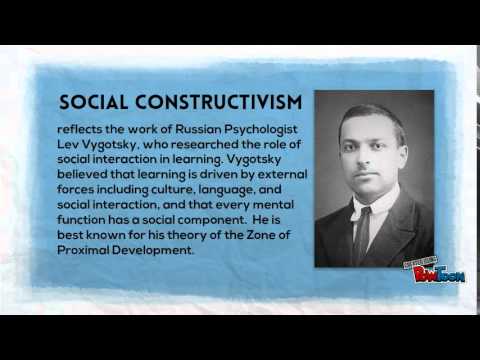
Constructivism — Piaget & Vygotsky
A concise overview of both cognitive and social constructivism, with classroom examples.
Guiding Questions
As you watch the video and work through the activities, keep these questions in mind:
- 1How does Piaget explain the process by which a child revises a mistaken belief?
- 2What does Vygotsky mean when he says learning precedes development?
- 3In what ways are scaffolding and fading two sides of the same coin?
- 4Can you think of a learning experience where social interaction was essential — not just helpful?
- 5How might a teacher use both theories simultaneously in a single lesson?
Development Activities (140 minutes)
Interactive Lecture
30 minutesSegment 1 · 15 min
Cognitive Constructivism
Piaget's Schema Formation
Fits?
Assimilation
Doesn't fit?
Accommodation
→ Equilibration restores balance
Concept Map — Match the Term
Segment 2 · 15 min
Social Constructivism
Padlet Prompt
“Share a metaphor for scaffolding in learning.”
Video Analysis
Observe the peer collaboration clip below. As you watch, note:
- 1Who is acting as the MKO?
- 2Where is the ZPD visible?
- 3How does the teacher scaffold without taking over?
Structured Small Group Work
40 minutesAnalyse the two case studies below. Your group is assigned one focus — then share findings with the class.
Case Study: Designing a History Lesson
A teacher wants students to understand the causes of World War I. She begins with a KWL chart (Know / Want to know / Learned), then has students individually examine primary sources and form their own explanations before any direct instruction.
Your task (individual exploration):
- ›Which Piagetian concepts are present?
- ›Where might disequilibrium occur?
- ›How does the KWL chart activate schemas?
Case Study: Designing a History Lesson
The same teacher restructures the lesson as a Socratic seminar. Students are assigned roles (questioner, devil's advocate, summariser) and debate the causes collaboratively, with the teacher asking probing questions to push thinking further.
Your task (group inquiry):
- ›Where is the ZPD operating in this lesson?
- ›Who is the MKO at different moments?
- ›How does language mediate learning here?
Output
Create a concept map (digital or poster) comparing both approaches. Be ready to present to the class.
Peer Teaching
20 minutesEach group teaches the class their assigned approach using the whiteboard or Miro board. The audience listens and completes the observation checklist below.
🗣️ Presenting Group
- 1Explain the core theory in your own words
- 2Walk through your case study analysis
- 3Show your concept map and explain the connections
- 4Invite one question from the audience
👂 Observing Group
- 1Note one thing you agree with
- 2Note one thing you would add or challenge
- 3Identify any constructivist principle they missed
- 4Prepare a question for the presenters
Case Study Analysis
30 minutesDiagnose the failing lesson plan below — which constructivist principles were ignored?
Failing Lesson Plan
Mr. Davis teaches a 60-minute lesson on photosynthesis entirely through a PowerPoint lecture. He reads from slides, students copy notes. There is no discussion, no prior knowledge check, no group work, and no opportunity to ask questions. At the end, students complete a fill-in-the-blank worksheet independently.
✗ No schema activation
Students' prior knowledge is never surfaced or connected to new content.
✗ No disequilibrium
Passive note-taking creates no cognitive tension to drive accommodation.
✗ No ZPD / scaffolding
No peer interaction, no MKO support, no gradual release of responsibility.
Scenario Quiz — What Would You Fix?
Scenario-Based Quiz: What Would You Fix?
Diagnose which constructivist principles were ignored
Classroom Scenario
Mr. Tan delivers a 60-minute lecture on photosynthesis with no student interaction. Students copy notes verbatim. On the test, most cannot explain why leaves turn yellow in autumn.
Which constructivist principle was most neglected?
Digital Flashcards
15 minutesQuizlet-style live game — test yourself on all key terms before the break.
Constructivism
Click to revealA learning theory where learners actively build knowledge through experience rather than passively receiving information.
Break — 15 minutes
Step away, recharge, and let the new schemas settle.
Synthesis
Rather than competing, cognitive and social constructivism are complementary lenses. Effective teaching draws on both:
Activate Prior Knowledge
Connect new content to existing schemas before introducing new concepts.
Create Productive Struggle
Design tasks that induce disequilibrium — just challenging enough to require accommodation.
Leverage Social Learning
Use peer work, discussion, and expert guidance to scaffold learning within the ZPD.
Assessment
Check Your Understanding
4 questions
1.According to Piaget, what happens when a child encounters information that does not fit an existing schema?
2.Which concept describes the range of tasks a learner can perform with guidance but not yet independently?
3.A teacher gradually removes hints as a student masters a skill. This best illustrates:
4.Which theorist is most associated with the social dimension of learning and the role of language?
Post-Test: How Far Have You Come?
Complete this after finishing all activities. Compare your results with the pre-test to measure your growth.
Post-Test
5 questions
1.Piaget's process of modifying an existing schema to incorporate new, conflicting information is called:
2.A teacher provides sentence starters and graphic organisers to help students write an essay, then removes them over time. This illustrates:
3.Which statement best captures the key difference between Piaget and Vygotsky?
4.According to Vygotsky, what is the primary role of language in learning?
5.A constructivist teacher designs a lesson where students first predict, then experiment, then revise their ideas. Which principle does this most reflect?
One-Minute Paper
Take 60 seconds to respond to each prompt in your notebook or learning journal. This is for your own reflection — not submitted.
The most important thing I learned today is…
One question I still have is…
One way I could apply this in a classroom is…
Differentiation Strategies
- Provide a glossary of key terms with visual examples
- Use worked examples before independent tasks
- Pair with a peer MKO for collaborative activities
- Reduce cognitive load with graphic organisers
- Complete all core activities and the Venn diagram
- Analyse the case study independently first
- Attempt the scenario quiz without hints
- Write a short paragraph comparing both theories
- Critique limitations of each theory with evidence
- Design a full constructivist lesson plan
- Research neo-Piagetian or sociocultural extensions
- Teach a concept to a peer and reflect on the process
Reflection: Connecting Theory to Practice
Reflection is itself a constructivist act — you are building new understanding by examining your own thinking. Use the prompts below for a journal entry or group discussion.
Theory ↔ Experience
Recall a learning experience from your own schooling. Which constructivist principles were present? Which were absent? How did that affect your learning?
Design Challenge
You are teaching a Year 8 class about the water cycle. Sketch a 20-minute activity that incorporates at least three constructivist principles from today's lesson.
Critical Lens
Constructivism has been criticised for being impractical in large classes or with content-heavy curricula. Do you agree? How would you respond to this critique?
Personal Growth
What is one belief about teaching or learning that this lesson has caused you to reconsider or refine? What new schema have you built?
Assessment Rubric
| Criterion | Excellent (4) | Proficient (3) | Developing (2) | Beginning (1) |
|---|---|---|---|---|
| Conceptual Accuracy | All key terms defined accurately with nuance | Most terms correct; minor imprecision | Some terms confused or incomplete | Significant misconceptions present |
| Theory Comparison | Insightful comparison with specific evidence | Clear comparison with some evidence | Superficial comparison; limited evidence | Theories conflated or not compared |
| Application to Practice | Creative, detailed, and theoretically grounded application | Relevant application with clear links to theory | Application present but loosely connected | Little or no connection to theory |
| Critical Reflection | Evaluates strengths and limitations; shows metacognition | Some evaluation; reflection is genuine | Descriptive rather than evaluative | Minimal or no reflection |
Constructive Alignment
| ILO | Teaching & Learning Activity | Assessment Task |
|---|---|---|
| Define constructivism | Lecture, flashcard activity | MCQ Quiz Q1 |
| Explain Piaget's concepts | Case study analysis, Venn diagram | MCQ Quiz Q1–2 |
| Describe Vygotsky's ZPD | Peer discussion, case study | MCQ Quiz Q2–3 |
| Compare both theories | Venn diagram, group debate | Short-answer essay |
| Apply to classroom design | Lesson plan workshop | Lesson plan submission |
Further Resources
Book
The Psychology of the Child
Piaget & Inhelder (1969)
Book
Mind in Society
Vygotsky (1978)
Article
Constructivism in Education
Jonassen, D. H. (1991)
Video
Piaget's Stages of Development
Khan Academy
Video
Vygotsky's ZPD & Scaffolding
Sprouts (YouTube)
Article
Scaffolding in the Classroom
Wood, Bruner & Ross (1976)